Home Curtain sizing & fullness
Will the curtains you already own fit a wider rod?
Published by Drape Notes
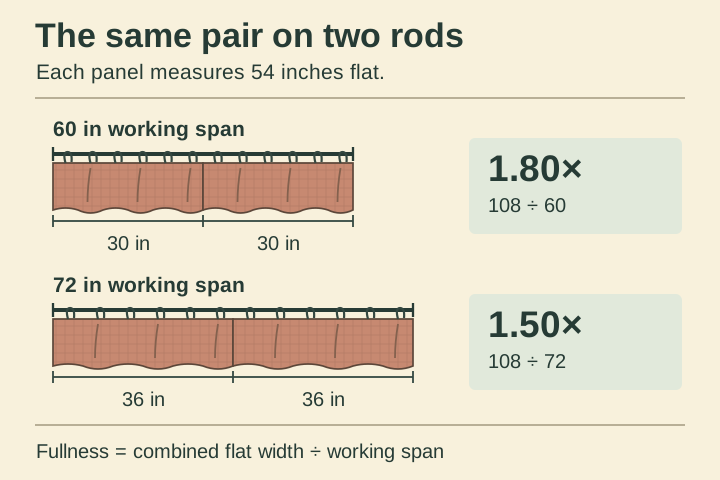
Measure the flat width of each existing panel and divide their combined width by each rod’s usable span. Two 54-inch panels give 1.80× fullness on a 60-inch rod and 1.50× on a 72-inch rod. Each panel now covers six more inches, leaving six fewer inches to form folds.
Try your pair on two rods
Use two matching panels measured flat. Enter the working span between the end stops on each rod, excluding finials. The example assumes a center opening with no returns or overlap.
Start with the curtains in your hands
Take down one panel at a time and lay it flat. For a simple clipped heading, smooth the fabric without stretching it and measure across the finished top from hem to hem at the sides. Repeat for its partner. If yours have sewn-in pinch pleats, measure the usable finished heading on the hardware and follow the maker’s guidance. Opening a stitched pleat just to recover a flat measurement would change the curtain.
Measure horizontally between the two outside points where the curtains actually hang on each proposed rod. Leave finials out. Keep the same heading, rings and split point in the comparison. These examples assume the panels meet at the center, with no overlap or fabric wrapping back to the wall.
Put both spans on the same piece of paper
Imagine that each panel measures 54 inches flat. On a 60-inch working span, the pair’s 108 inches divided by 60 gives 1.80× fullness. Each side covers 30 inches, leaving 24 inches of width per panel to distribute into folds. That 24-inch allowance is the sum across the panel. It does not tell you how deep any one fold will hang.
On a 72-inch working span, the same 108 inches divided by 72 gives 1.50×. The new center is 36 inches from either working end. Subtract 36 from 54 and 18 inches per panel remain for folds. The rod gains 12 inches across the opening, but each curtain only travels six inches farther in a symmetric split.
Try one half at its new width
On a suitable existing pole, mark a 36-inch test span and dress one panel across it with the original clip spacing. Compare the folds at eye level and look at the leading edge. If the curtains need to overlap or turn toward the wall, reserve that coverage before judging the folds. A panel that just meets its partner leaves little room for a privacy overlap.
If one panel is narrower after washing, compare each measured width against its own side of the rod. The total ratio can hide one relatively taut side. Before fixing brackets, also slide the pair open. Fullness describes the closed curtains. The amount of glass exposed depends on where the open stacks land.